Checklist: Coordinating quality checks across suppliers
When several suppliers make related products, inconsistent inspection instructions can create conflicting results and late disputes. Buyers need one controlled requirement set, risk-based checkpoints, traceable records, and a clear decision path for failures. A shared framework makes suppliers comparable while preserving product-specific checks for different materials, processes, and risks.
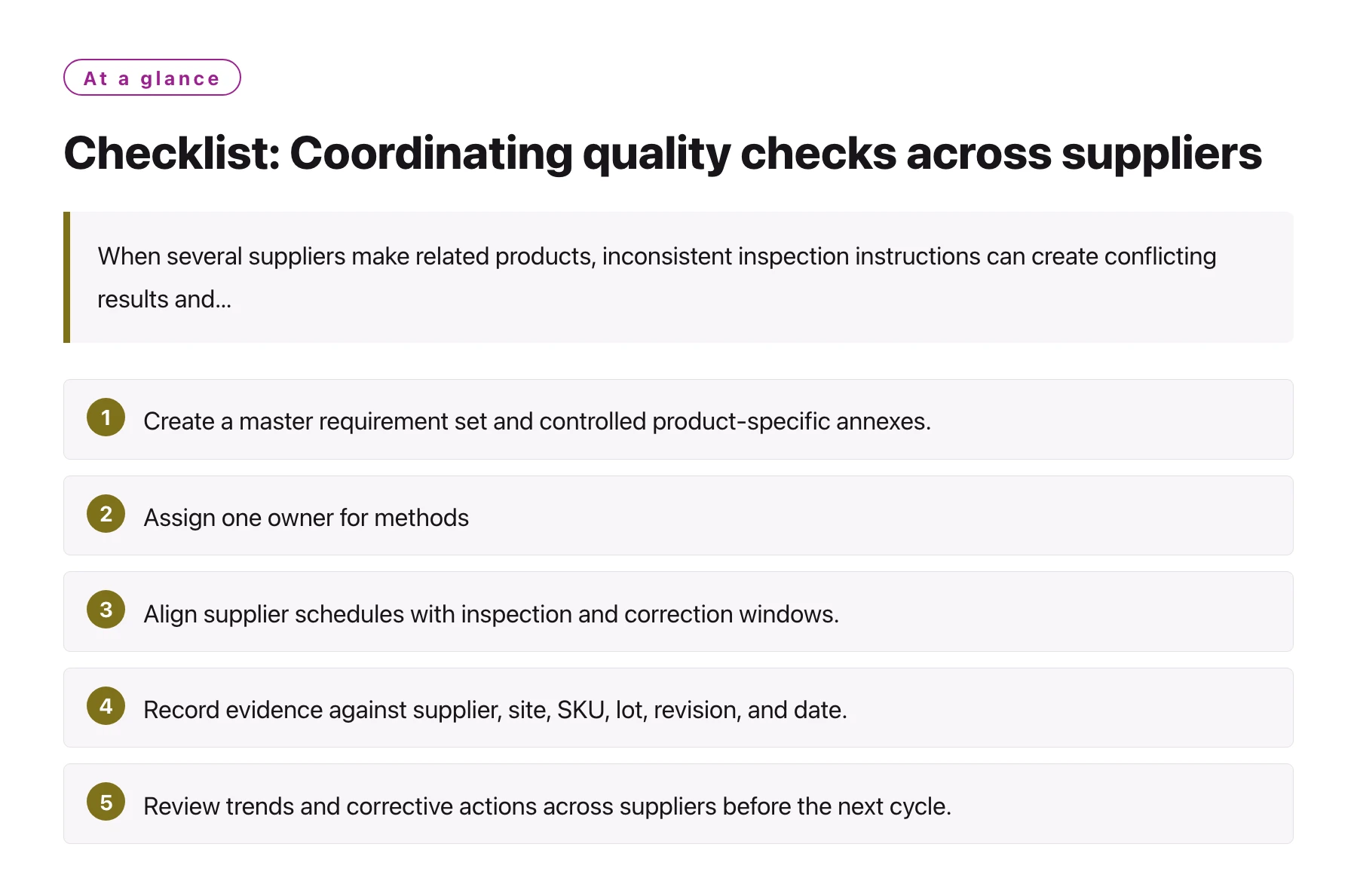
Key takeaways
- Create a master requirement set and controlled product-specific annexes.
- Assign one owner for methods, sampling, findings, and release decisions.
- Align supplier schedules with inspection and correction windows.
- Record evidence against supplier, site, SKU, lot, revision, and date.
- Review trends and corrective actions across suppliers before the next cycle.
A coordinated quality plan connects commercial requirements, technical criteria, inspection evidence, and shipment decisions across every supplier.
1. Establish the governance and ownership
Name the buyer-side quality owner and identify technical, regulatory, procurement, and logistics decision makers. Define who approves specifications, inspection plans, deviations, corrective actions, and shipment release. Suppliers need a named counterpart who can resolve questions without relying on informal chat history.
Document escalation timing and backup contacts. A defect that affects several suppliers should be assessed centrally so one vendor is not allowed to ship while another is held for the same underlying issue. Keep a decision log with date, scope, rationale, approver, and affected lots.
2. Build a controlled common requirement set
Create a master checklist for shared requirements such as identity, labeling, packaging, workmanship, documents, traceability, and reporting. Attach product-specific drawings, critical dimensions, performance limits, materials, or safety criteria as controlled annexes. Assign a revision and effective date to each document.
Ask each supplier to acknowledge the applicable versions before production. Maintain a change log and withdraw obsolete forms. ISO 9001 describes quality management system requirements, including controlled processes and continual improvement; use the current standard as a management reference and confirm the edition and scope relevant to the supplier. [1]
3. Rank risks and select control points
Map product and process risks by severity, likelihood, detectability, and customer impact. Identify points where a defect can still be corrected economically: incoming materials, first production, in-process operations, final assembly, packaging, and loading. Increase attention for new products, new factories, high-impact characteristics, or weak performance history.
Do not apply identical sampling to every product by habit. State the reason for each check, the failure modes it addresses, and who owns the control. A low-risk packaging check may use a different method from a safety-critical functional requirement or regulated product review.
4. Standardize methods and acceptance criteria
For each check, record the characteristic, method, equipment, units, sample size, acceptance limit, environmental condition, and required evidence. Use clear pass, fail, or pending outcomes. If visual inspection is involved, include reference images or examples and explain how borderline conditions are escalated.
Train inspectors and suppliers on the same work instructions. Where judgment is subjective, compare results between inspectors using known examples. Calibrate measurement equipment at defined intervals and retain calibration status with reports. Differences in method can produce apparent supplier differences that are only differences in measurement.
5. Coordinate samples, dates, and access
Maintain a shared calendar with production readiness, inspection notice, planned visit, report deadline, correction window, reinspection, booking cutoff, and shipment release. Require each supplier to provide realistic production status and lot readiness before a visit is confirmed.
Specify factory access, safety induction, sample availability, operating conditions, and records to be ready. When using third-party inspectors, send them the same revision-controlled plan and contact details. Record cancellations, inaccessible goods, or incomplete production because these affect the validity of the inspection result.
6. Link findings to lots and corrective action
Each report should identify supplier, site, product, SKU, drawing revision, order, lot, date, sample basis, method, results, photos, and exceptions. Link a nonconformance to affected quantity and containment status. Avoid reports that merely say “passed” without defining scope or evidence.
For failures, request containment, root-cause analysis, corrective action, owner, due date, and verification evidence. Track recurring defects across suppliers and product families. A replacement or rework plan should identify how corrected goods will be distinguished and reinspected before release.
7. Set shipment release and deviation rules
State which failures block shipment, who may authorize a concession, and what evidence must be closed before release. A commercial deadline does not convert a failed critical requirement into acceptance. If a waiver is considered, record affected lots, temporary scope, risk review, customer authorization where needed, and expiry.
Separate quality release from customs paperwork, freight booking, and destination receipt. Ensure logistics teams can see hold status and do not dispatch goods while an unresolved critical finding remains. Require the supplier to communicate lot changes after inspection or before loading.
8. Compare supplier performance fairly
Use a consistent scorecard with defect rate, repeat findings, schedule adherence, response time, corrective action effectiveness, documentation completeness, and change control. Define the period, denominator, severity weighting, and exclusions. Compare suppliers producing similar products and under comparable inspection coverage.
Review context before drawing conclusions. More intensive inspection can reveal more defects than a lighter plan. Track both findings and detection effort. Share trend results with suppliers and use them to adjust support, control frequency, capacity allocation, or sourcing decisions.
9. Review the system after each order cycle
After delivery, reconcile inspection reports, receiving defects, customer complaints, damage, returns, and unresolved actions. Identify gaps between factory inspection and downstream experience. Update checklists only through controlled revision so active orders remain tied to the criteria they were promised.
Buyers working with Shanghai JS Sourcing can coordinate specifications, supplier communication, inspection timing, and shipment decisions through a common record. The practical outcome is a traceable decision for each supplier and lot, with clear evidence for approval, hold, corrective action, or reinspection.
Sources
Frequently asked questions
Should all suppliers use the same inspection sample size?
Not automatically. Base the plan on product risk, lot size, process history, contract criteria, and failure consequences.
Who should release a shipment after inspection?
A named buyer-side authority should confirm required results, close critical findings, and approve any documented deviation.
What makes inspection reports comparable?
Shared revisions, methods, units, sample rules, lot identity, acceptance limits, evidence, and reporting fields.
How often should the control plan be reviewed?
Review after each order cycle and whenever product, process, supplier performance, requirements, or risk changes.