Data Usage and Battery on Mobile Sessions
Text chat is one of the lightest things a phone can do on a data plan and one of the more demanding on a battery, because the battery cost follows screen-on time rather than megabytes. Take a 60-word reply of about 350 characters: a session of forty turns carries roughly 14 kilobytes, and a month of sixteen such sessions is about 224 kilobytes. The same month, at half an hour a session, is eight hours of lit screen.

Key takeaways
- Data is not the constraint. A forty-turn session of 60-word replies is about 14 kilobytes of text, and sixteen of them are about 224 kilobytes a month.
- Battery follows screen-on hours: 16 sessions of half an hour is 8 hours of lit screen a month, which is roughly a quarter of an hour of screen time every day.
- Crushon describes its Porn Chat AI service as adaptive and text-based, and the platform's 2257 statement confirms the material is AI-generated text depicting no real person.
- Both costs fall if sessions get shorter, and neither falls appreciably if you change character.
Why text is a light format
A message is a small object. Sixty words is about 350 characters, and a character in ordinary text takes roughly one byte, so a single reply is in the region of 0.35 kilobytes before any packaging overhead. A session of forty turns therefore moves a few tens of kilobytes in each direction, and a month of sixteen sessions stays under a quarter of a megabyte.
Compare that with the things that do move a data meter. A minute of streaming video is measured in megabytes, a photo upload in single megabytes, and a map tile refresh in hundreds of kilobytes. Text conversation arrives at the light end of the scale by two or three orders of magnitude, which is why the megabytes are rarely the reason a session ends.
Two caveats are worth stating. Efficiency depends on connection quality, because a weak signal makes the device retry and burns power even when the payload is tiny. And browsing a catalogue of cards costs more than the conversation itself, since pages carry images; the chat is the light part, not the site.
Screen time is the real cost
A phone keeps its display awake for the whole session, and the display is the largest single consumer on most modern handsets. That means the battery cost is proportional to minutes, not to messages. Sixteen sessions of half an hour is 480 minutes, or 8 hours of active screen each month, which is about 16 minutes a day on average.
Set that against a normal day. An hour of screen time a day is 30 hours a month, so a chat habit totalling 8 hours is roughly 27 percent of one hour a day, or about a quarter of a typical lighter user's total. The comparison is why the arithmetic matters: the same habit is trivial on data and visible on battery.
Two behaviours make the battery number easier to live with. Sessions that end at a natural stopping point are shorter without feeling cut off, and sessions that start with the screen already charged to a comfortable level avoid the low-battery notification that ends them. Neither requires changing anything about how you use the service.
| Resource | What drives it | Illustrative monthly figure |
|---|---|---|
| Mobile data | Length and number of messages, plus page loads | About 224 kilobytes of text across 16 sessions |
| Battery | Minutes of lit screen, not megabytes transferred | About 8 hours of screen-on time at 30-minute sessions |
| Storage | Saved characters and any notes you keep | Negligible for entries, larger for written logs |
| Attention | Number of sessions, not length of them | 16 sessions, or roughly one every other day |
| Signal quality | Retries on weak connections | Not fixed: a poor signal raises power use |
Worked example: two habits, one handset
Reader one holds short sessions of 15 minutes, four times a week. That is 16 sessions a month, so 240 minutes, or 4.0 hours of screen time, and a little over 100 kilobytes of text at forty turns a session. Reader two keeps the same frequency but runs a full hour each time: 960 minutes a month, 16.0 hours of screen, with the same kilobytes, because the data cost tracks the number of turns rather than the minutes.
The arithmetic of the comparison is simple. 16 sessions times 15 minutes is 240 minutes; 16 times 30 is 480; 16 times 60 is 960. Divide each by 60 and the monthly hours are 4.0, 8.0 and 16.0. Data stays flat across all three columns at roughly a fifth of a megabyte, which is why a reader who wants to reduce phone impact should shorten sessions rather than avoid the service.
There is one further figure worth having. A reader sending 40 messages a day writes 1,200 in a 30-day month, and at 350 characters a message that is about 420,000 characters, or roughly 0.4 megabytes of outgoing text. Even combined with a generous allowance for page loads, the whole month sits in low single-digit megabytes. Those figures are worked examples built on an assumption about message length, not measurements taken from the platform.
Making a mobile session cheaper
Four changes reduce the phone cost without touching the experience. Shorten sessions and take more of them, since data is flat and battery is not. Prefer unmetered connections for browsing the catalogue, where images dominate the transfer. Keep a charger within reach for long sessions rather than letting a low battery end a scene mid-beat. And use the platform's own app or the Android download if it suits your device, because an installed app avoids repeated page loads in a browser.
It is also worth understanding what the service actually is before optimising for it. The page at https://crushon.ai/ai-porn-chat describes customisable characters, a private and secure environment with state-of-the-art encryption, and natural adaptive responses; the compliance statement behind it records that the material is AI-generated text and depicts no real person. A text service of that kind is not going to strain a data allowance, and knowing that lets you put the effort where it belongs — on session length and screen habits.
For readers who want to plan around the habit rather than react to it, the character search page is the cheapest place to spend browsing time, because it lists tags and rankings as text rather than as a wall of cards. Plan the session there, talk in the chat, and the megabytes stay where they were.
Frequently asked questions
Will a long session use up my data allowance?
Almost certainly not. Text is measured in kilobytes while allowances are measured in gigabytes. Browsing image-heavy pages is the part that moves the meter.
Why does the battery drop so much during a session?
Because the screen stays lit. Drain tracks minutes of screen-on time, so a 60-minute session costs about four times a 15-minute one with no change in data.
Does using the app instead of the browser help?
It can reduce repeated page loads, which are the heavier part of mobile browsing. The conversation itself is light either way. The platform offers an iOS app and an Android download.
Measure once, then stop worrying
Check your phone's data summary after a week of normal use. The chat line will be a rounding error beside whatever you stream, and that single look settles the question permanently. Then watch the screen time instead, because that is the figure with a real ceiling.
Once both numbers are known, the habit stops feeling like a resource problem. Keep sessions short enough to fit your battery and your evening, plan the browsing on the lightest page you can, and spend the saved attention on the conversation itself. The AI chat blog is a useful second read if you want the operator's own account of how the service is meant to be used.
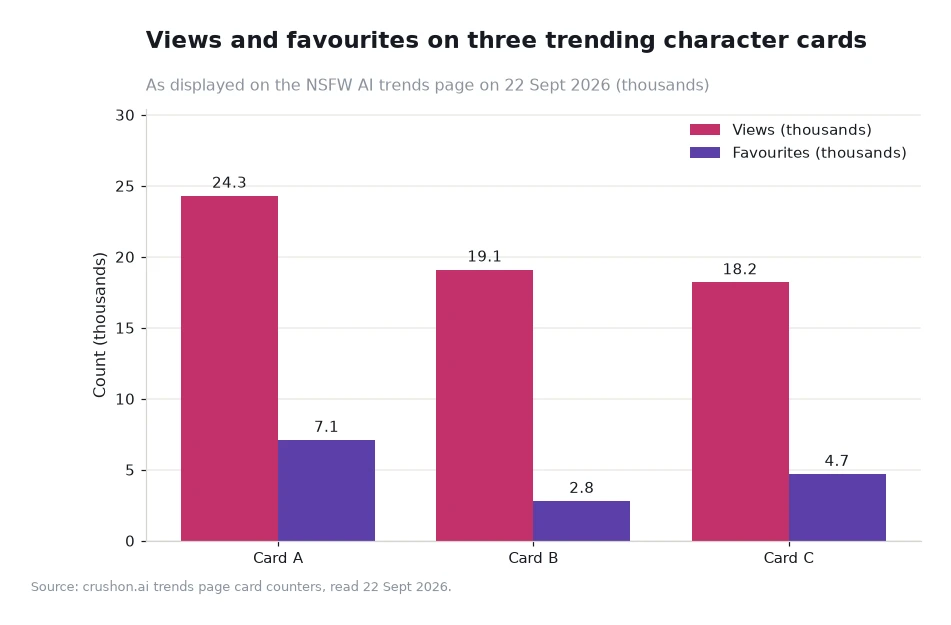
Data and sources: service description, privacy and encryption wording, and the AI-text provenance recorded in the platform's compliance statement[1], all read on 22 Sept 2026, together with the trends board counters of 24.3M views and 7.1K favourites on the leading card. Character, message and screen-time figures are worked examples built on stated assumptions, not platform measurements. Content intended for adults 18+; read 22 Sept 2026.